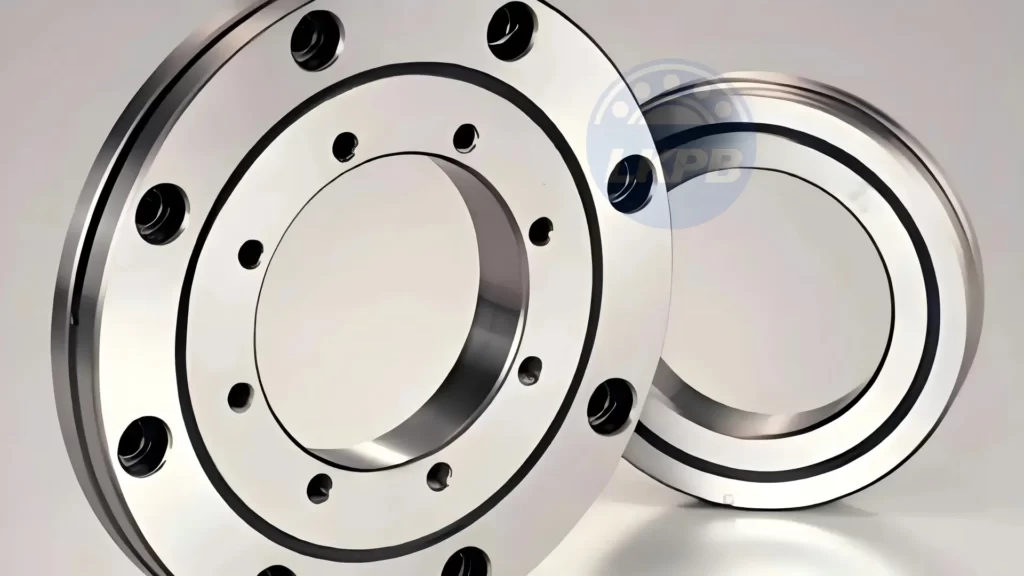
Industrial robots demand components that deliver exceptional precision, rigidity, and reliability under continuous multi-axis operation, heavy loads, and tight spaces. Bearings are critical to performance, directly affecting repeatability, speed, energy efficiency, and service life. Among the options, Cross Roller Bearings and bearings designed for Harmonic Drive systems stand out as top choices for modern robotic applications.
As a precision bearing manufacturer with deep expertise in high-accuracy components for automation, LKPB has helped global OEMs and system integrators optimize robot joints for years. This guide compares Cross Roller Bearings and Harmonic Drive bearings, highlights why precision Cross Roller Bearings often provide the best balance for industrial robots, and offers practical selection advice.
Why Bearings Matter in Industrial Robot Design
Modern 6-axis articulated robots, SCARA, delta, and collaborative robots (cobots) rely on bearings in every joint—from the base and shoulder to the wrist and end-effector. These bearings must handle combined radial, axial, and moment (tilting) loads while maintaining sub-micron positioning accuracy and minimal backlash.
Key performance demands include:
- High rigidity to resist deflection under dynamic loads.
- Precision rotation for repeatable motion (often P4 or P2 class).
- Compact, lightweight design to reduce robot inertia and energy use.
- Low friction and smooth operation for high-speed cycles and energy efficiency.
- Long service life with minimal maintenance in 24/7 industrial environments.
Failure to select the right bearing leads to vibration, reduced accuracy, premature wear, or costly downtime. Top-performing systems pair high-precision reducers (like harmonic drives) with robust output bearings.
Understanding Cross Roller Bearings for Robotics
Crossed Roller Bearings (also called crossed cylindrical roller bearings) feature cylindrical rollers arranged at 90° angles in a V-shaped raceway. This orthogonal arrangement allows a single bearing to support loads from all directions simultaneously—radial, axial (both ways), and moment loads—without needing additional support bearings.
Key Advantages for Industrial Robots:
- Superior Rigidity and Load Capacity: The line contact of rollers provides high stiffness (often 3-4 times that of angular contact ball bearings) and excellent resistance to deflection. Ideal for heavy payload robots or applications with significant moment loads, such as welding, material handling, or palletizing.
- High Rotational Accuracy: Minimal elastic deformation and low runout enable precise positioning, critical for assembly, inspection, and machining robots.
- Compact Design: They save space compared to combinations of ball bearings, allowing slimmer robot arms and lower overall weight.
- Easy Integration: Many designs feature split inner/outer rings with mounting holes, simplifying installation and reducing assembly errors.
- Low Friction and High Speed Capability: Optimized roller geometry and cages reduce torque and heat generation.
LKPB’s Precision Cross Roller Bearings, available in series like RB, RE, RU, RA, CRBH, and more (ID from 20mm to 2000mm+), achieve P5, P4, or P2 precision grades. They are manufactured from high-strength bearing steel with advanced heat treatment for superior wear resistance and fatigue life.
Harmonic Drive (strain wave) gearboxes dominate many robot joints due to their zero-backlash, high reduction ratios (often 50:1 to 160:1), and compact form. They require specialized bearings:
- Flexible Bearings (for the wave generator): Thin-section ball bearings designed to deform elliptically with the flex spline. They handle primarily radial loads with some axial capability but prioritize flexibility over extreme rigidity.
- Rigid Cross Roller Output Bearings: High-precision crossed roller bearings integrated or paired at the output for supporting the flex spline and handling output loads with high stiffness and precision.
Harmonic systems excel in applications needing extreme compactness and high torque density, such as robot wrists or lightweight cobots. However, the flexible bearing component introduces design trade-offs in load capacity and long-term durability under heavy or highly dynamic loads.
Cross Roller vs Harmonic Drive Bearings: Head-to-Head Comparison
| Aspect | Precision Cross Roller Bearings | Harmonic Drive Bearings (Flexible + Output) | Winner for Most Robots |
|---|
| Multi-Directional Load | Excellent (radial + axial + moment in one unit) | Good (output strong; flexible limited) | Cross Roller |
| Rigidity/Stiffness | Very High | High (output); lower for flexible part | Cross Roller |
| Precision/Accuracy | P2-P5 class, minimal deflection | Excellent zero-backlash when paired | Tie (application dependent) |
| Compactness | Very Good | Excellent (integrated design) | Harmonic |
| Friction & Efficiency | Low | Very Low (system level) | Harmonic |
| Cost-Effectiveness | High (direct drive or simpler integration) | Higher system cost | Cross Roller |
| Service Life & Maintenance | Long, robust under load | Good, but flexible bearing wear possible | Cross Roller |
| Best Applications | Joints with high moment loads, rotary tables, heavy arms | High-reduction precision joints, wrists | – |
Cross Roller Bearings often emerge as the stronger all-round choice for output positioning and heavy-duty joints. They can serve as direct high-precision bearings or as robust complements to harmonic reducers. Many manufacturers, including LKPB, produce both standard Cross Roller and harmonic-specific variants for seamless integration.
Real-World Applications in Industrial Robots
- Waist/Shoulder/Base: High moment loads favor large Cross Roller Bearings (e.g., RB or RU series) for stability.
- Elbow and Forearm: Balanced load and precision needs—Cross Roller shines here.
- Wrist: Compact harmonic systems with integrated or paired Cross Roller output bearings for fine motion.
- Rotary Tables and Positioners: Almost exclusively high-rigidity Cross Roller designs.
Case studies from automation leaders show that upgrading to precision Cross Roller Bearings improves repeatability by 20-50% and extends mean time between failures in demanding 24/7 lines.
How to Select the Best Bearings for Your Industrial Robot
- Define Load Requirements: Calculate radial, axial, and moment loads with safety factors for dynamic operation.
- Precision Grade: Choose P4 or better for most positioning tasks.
- Size and Mounting: Consider inner/outer diameter, height, and interface (e.g., with mounting holes).
- Speed and Duty Cycle: Verify limiting speeds and lubrication needs (grease vs. oil).
- Environment: Dust, temperature, or cleanroom requirements may need seals or special materials.
- Integration with Reducer: Ensure compatibility with harmonic, RV, or cycloidal drives.
Pro Tip: Work with an experienced supplier early in the design phase. LKPB’s engineering team provides custom calculations, 3D models, and application-specific recommendations.
Common Questions About Robot Bearings (FAQ)
Q: Can Cross Roller Bearings replace Harmonic Drive components? A: Yes, in many output or support positions. LKPB Precision Cross Roller Bearings are direct drop-in alternatives or upgrades for IKO, THK, HIWIN, and other brands, often at better value with equivalent or superior performance.
Q: How do I reduce backlash in robot joints? A: Combine zero-backlash harmonic reducers with high-rigidity Cross Roller output bearings. Preload options further minimize play.
Q: What is the expected service life? A: With proper selection and lubrication, LKPB bearings routinely exceed 20,000-50,000 hours in robotic use, depending on loads.
Q: Are they suitable for collaborative robots (cobots)? A: Absolutely. Lightweight and compact Cross Roller designs help meet safety and payload requirements.
Q: How important is customization? A: Critical for OEMs. Non-standard dimensions, special preload, coatings, or integrated sensors can optimize weight, performance, and cost.
Why Choose LKPB Precision Cross Roller Bearings
LKPB is a trusted Chinese manufacturer of high-precision bearings, specializing in Cross Roller and Rotary Table Bearings. Our products consistently match or exceed the performance of established global brands while offering competitive pricing, shorter lead times, and full OEM customization support.
- Quality Assurance: ISO-certified processes, advanced CNC grinding, and 100% inspection.
- Proven Equivalents: Perfect replacements for popular IKO, THK, HIWIN models.
- Global Support: Serving customers in Europe, North America, Asia, and beyond with English technical documentation and responsive engineering.
- Innovation: Continuous R&D for higher speeds, lower torque, and specialized robotics variants.
Whether you need off-the-shelf precision bearings or fully custom solutions for next-generation robots, LKPB delivers reliability you can trust.
Take the Next Step: Partner with Experts for Your Project
Ready to optimize your industrial robot’s performance with the best bearings? Contact the LKPB team today for a free application review, load calculations, or prototype samples. Our OEM and custom manufacturing services help you bring superior robots to market faster and more cost-effectively.
Request a Quote or schedule a technical consultation now. Discover how switching to or specifying LKPB Precision Cross Roller Bearings can elevate your robot’s accuracy, durability, and competitiveness.
Article Keywords
Best Bearings for Industrial Robots, Cross Roller Bearings, Harmonic Drive Bearings, Precision Cross Roller Bearings, Robot Joint Bearings, Industrial Robot Bearings, Crossed Roller Bearings for Robotics, LKPB Bearings, THK IKO HIWIN alternatives, High Precision Bearings Robotics, Robotic Arm Bearings, OEM Custom Bearings.