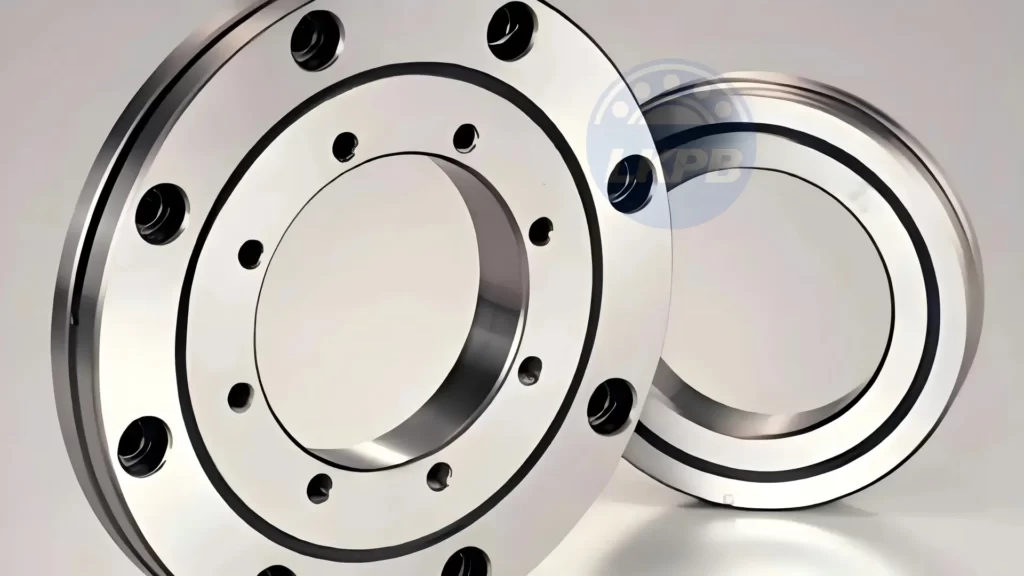
Cross Roller Bearing

Advantages of Cross Roller Bearings: Precision, Rigidity, and Performance for Demanding Applications

LKPB Cross Roller Bearings

In the world of precision machinery, where every micron counts and downtime is costly, cross roller bearings stand out as a superior choice for engineers and OEMs seeking unmatched reliability. If you are evaluating bearing solutions for high-precision rotary motion applications such as robots, machine tools, medical equipment or semiconductor equipment. These specialized bearings deliver exceptional rigidity, load capacity, and accuracy in a compact package—qualities that make them indispensable in modern industrial applications.

At LKPB, a precision bearing manufacturer based in China, we specialize in high-quality Precision Cross Roller Bearings engineered to match or exceed the performance of leading brands like IKO, THK, and HIWIN. Our bearings provide cost-effective, readily available alternatives without compromising on quality, helping global customers reduce lead times and total ownership costs while maintaining peak machine performance.

What Are Cross Roller Bearings?

Cross roller bearings—also known as crossed roller bearings or cross roller rings—feature a unique design where cylindrical rollers are arranged at 90-degree angles to one another between the inner and outer rings. This orthogonal (crossed) configuration creates line contact between the rollers and raceways, as opposed to the point contact typical of ball bearings.

The rollers are separated by spacers or retainers to prevent skewing, tilting, or direct contact, ensuring smooth rotation with minimal friction. Many designs feature split inner or outer rings, allowing for preload adjustment and easy installation. This structure enables the bearing to support radial loads, axial loads, and moment (tilting) loads simultaneously from any direction—all within a single, space-efficient unit.

Unlike recirculating ball bearings, cross roller bearings are typically non-recirculating, which eliminates vibration from balls entering and exiting the load zone. The result? Smoother, quieter operation and higher positional accuracy, even under heavy or complex loading conditions.

This design isn’t just theoretical. In practice, it translates directly into the advantages of cross roller bearings that engineers value most: superior stiffness, precision, and versatility.

CRBS608

Key Advantages of Cross Roller Bearings

1. Exceptional Rigidity and Load-Bearing Capacity

One of the standout advantages of cross roller bearings is their outstanding rigidity. The line-contact geometry provides a much larger contact area than ball bearings, distributing loads more evenly and minimizing elastic deformation. Industry data consistently shows cross roller bearings can achieve 3–4 times the rigidity of conventional bearings under equivalent loads.

They handle combined radial, axial, and moment loads with ease. A single cross roller bearing can often replace two or more traditional bearings, simplifying designs and reducing assembly weight. This multi-directional load capability is especially valuable in applications involving tilting moments, such as robot arms or rotary tables.

For OEMs dealing with heavy payloads or high dynamic loads, this means less deflection, better stability, and longer structural integrity of the entire machine.

2. Superior Rotational Accuracy and Precision

Precision is non-negotiable in industries like medical imaging, semiconductor manufacturing, and CNC machining. Cross roller bearings excel here because their crossed arrangement and preload capability virtually eliminate clearance. Rotational runout can be held to extremely tight tolerances—often in the micron range—delivering consistent, repeatable motion.

The absence of recirculating elements further enhances accuracy by removing the “pulsation” effect common in linear ball guides. Motion remains smooth and predictable even during short-stroke or high-acceleration cycles. Engineers searching for advantages of cross roller bearings frequently highlight this as the reason these bearings outperform alternatives in high-speed indexing or positioning tasks.

3. Compact Design and Significant Space Savings

Space constraints drive many modern machine designs. Cross roller bearings feature ultra-thin profiles with minimized inner and outer ring dimensions while retaining high rigidity. Their compact footprint allows designers to shrink overall machine size without sacrificing performance.

In robotic joints or medical equipment where every millimeter matters, this space-saving advantage directly contributes to lighter, more agile systems. One bearing does the work of multiple components, lowering material costs and simplifying the bill of materials (BOM).

4. Low Friction, Smooth Operation, and Reduced Torque

Friction torque in cross roller bearings remains remarkably low thanks to the roller separators and optimized raceway geometry. Operation is quiet and vibration-free—critical for sensitive applications like laboratory automation or aerospace instrumentation.

Lower friction also means reduced energy consumption and heat generation, extending lubricant life and enabling higher operating speeds in certain configurations. Maintenance intervals lengthen, and overall system efficiency improves.

5. Easy Installation and Maintenance

Standard crossed roller bearings often come with a split-ring design (inner or outer ring divided into two parts). This allows quick assembly, fine-tuning of preload via mounting bolts, and straightforward inspection. No complex alignment procedures are typically required, reducing installation time and the risk of mounting errors.

For B2B customers, this translates to faster machine build cycles and lower labor costs on the production floor.

6. Extended Service Life and Enhanced Durability

The combination of line contact, even load distribution, and minimal wear leads to longer bearing life. Cross roller bearings resist shock, vibration, and repetitive loading far better than many alternatives. With proper lubrication and sealing (where applicable), they deliver reliable performance over millions of cycles.

This durability reduces unplanned downtime—a major concern for manufacturers running 24/7 operations.


Cross Roller Bearings vs. Other Bearing Types: Side-by-Side Comparison

To fully appreciate the advantages of cross roller bearings, consider this practical comparison:


FeatureCross Roller BearingsBall BearingsTapered Roller Bearings
Load Capacity (Multi-directional)Excellent (radial + axial + moment)ModerateGood (primarily radial/axial)
RigidityVery High (3–4x conventional)ModerateHigh
Rotational AccuracyExceptional (micron-level)GoodModerate
CompactnessExcellent (ultra-thin)GoodModerate
Friction/TorqueVery LowLowModerate
Installation EaseHigh (split-ring options)HighModerate
Space EfficiencySuperior (one replaces multiple)ModerateLower
Typical ApplicationsRobots, machine tools, medicalGeneral purposeHeavy-duty conveyors
 

Cross roller bearings consistently outperform in precision-critical, space-limited environments where complex loads are present.

RU Crossed Roller Bearing

Real-World Applications Driving Demand

The advantages of cross roller bearings shine brightest in high-stakes industries:

  • Industrial Robotics: Joints and rotary actuators benefit from high rigidity and moment-load capacity, enabling faster, more precise movements.
  • Machine Tools & CNC: Rotary tables and spindles achieve sub-micron accuracy with minimal deflection.
  • Medical & Life Sciences: Imaging equipment, surgical robots, and lab automation require smooth, quiet, contamination-resistant motion.
  • Semiconductor & Electronics: Wafer handling and pick-and-place systems demand cleanroom-compatible precision.
  • Aerospace & Defense: Radar antennas, satellite mechanisms, and aircraft seating systems leverage compact size and reliability under extreme conditions.

LKPB’s Precision Cross Roller Bearings are already trusted in these sectors worldwide, offering direct drop-in compatibility with IKO, THK, and HIWIN models.

Choosing the Right Cross Roller Bearings: Expert Guidance

When specifying bearings, consider load ratings, speed, mounting orientation, environmental factors (temperature, cleanliness), and required accuracy class. Preload options (light, medium, heavy) allow fine-tuning for your specific application.

At LKPB, we provide full technical support, including 3D models, load-life calculations, and custom sizing. Our bearings are manufactured to ISO standards using premium materials and rigorous quality control—ensuring they perform identically to premium imported brands while offering faster delivery and competitive pricing.


Frequently Asked Questions (FAQ)

Q: What are the main advantages of cross roller bearings over ball bearings? 

A: Cross roller bearings provide higher rigidity, better multi-directional load handling, and superior accuracy due to line contact versus point contact. They also reduce space requirements and vibration.

Q: Can cross roller bearings replace IKO, THK, or HIWIN models? 

A: Yes. LKPB Precision Cross Roller Bearings are engineered as high-performance equivalents, with matching dimensions, load ratings, and precision classes for seamless integration.

Q: How do I prevent premature wear in cross roller bearings? 

A: Use recommended lithium-based grease, maintain proper preload, protect against contamination, and follow mounting torque specifications. Regular inspection of mounting surfaces is key.

Q: Are they suitable for high-speed applications? 

A: Absolutely, within design limits. Their low friction torque supports higher speeds than many roller bearings while maintaining accuracy.

Q: What customization options are available for OEM projects? 

A: LKPB offers custom bore sizes, special materials (stainless steel, coatings), integrated mounting flanges, and application-specific preload or sealing solutions.

Q: How do cross roller bearings improve machine uptime? 

A: Through longer life, lower maintenance needs, and reduced vibration—directly lowering total cost of ownership.


Partner with LKPB for OEM and Custom Manufacturing Solutions

Ready to harness the advantages of cross roller bearings in your next project? Whether you need standard Precision Cross Roller Bearings or fully customized solutions for unique OEM requirements, LKPB delivers.

Our Chinese manufacturing facility combines advanced production technology with competitive pricing and short lead times. We specialize in helping global customers replace expensive imported bearings without sacrificing performance. From prototype to high-volume production, our engineering team works side-by-side with yours to optimize designs, reduce costs, and accelerate time-to-market.

Contact LKPB today for a free technical consultation, detailed quotes, or samples. Discover how our Precision Cross Roller Bearings can elevate your machinery’s accuracy, rigidity, and reliability—while strengthening your bottom line.

Article Keywords: Advantages of cross roller bearings, cross roller bearings advantages, precision cross roller bearings, crossed roller bearings, high rigidity bearings, high precision bearings, cross roller ring, replace IKO cross roller bearings, replace THK cross roller bearings, replace HIWIN cross roller bearings, LKPB bearings, industrial robot bearings, machine tool bearings, OEM cross roller bearings, custom cross roller bearings.

For expert guidance in meeting your specific requirements, reach out to our knowledgeable team. Experience firsthand how our precision solutions can elevate your machinery’s efficiency and durability. Contact us today!

LKPB With more than 10 years of production experience

Supporting OEM service; 50 days return service; 7*24 hours technical support; Accept non-standard customization; Maximum 24 months product warranty

LKPB®

Get a free quote fast

Please let us know the product model and quantity you need and we will provide the most competitive quote! Alternatively, you can contact our knowledgeable customer service team

Email: [email protected]  WhatsApp/Wechat: +86 13613886217